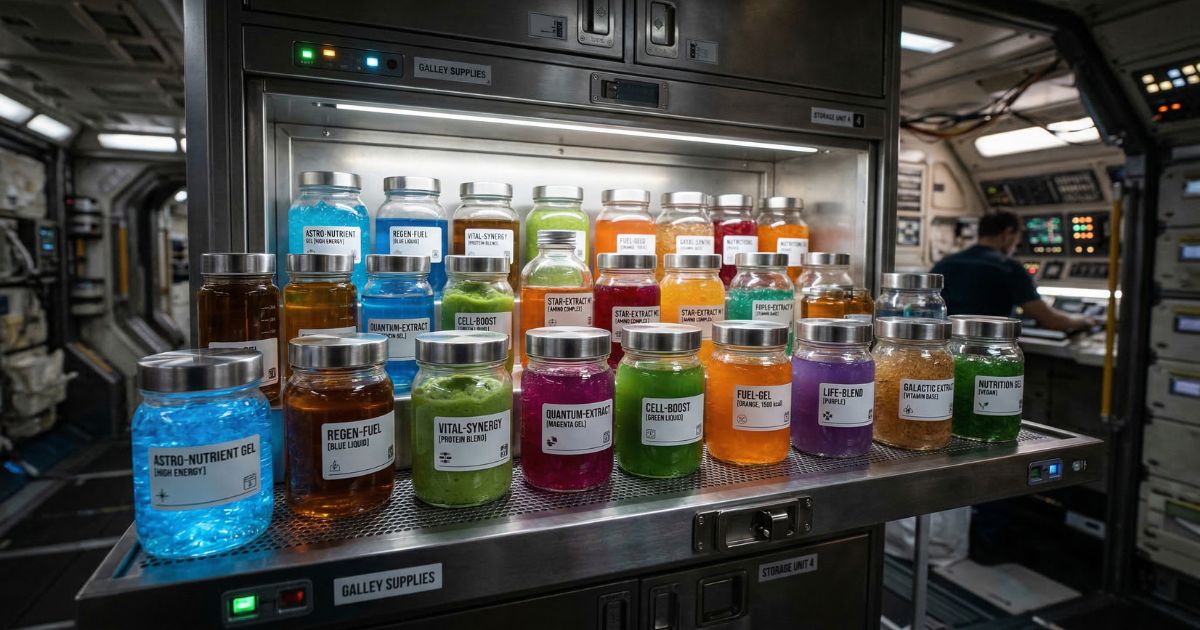
Food for a Long-lived Civilization
An extremely long lifespan will not be sustained by nostalgia.
It will not be sustained by pastoral fantasies, artisanal virtue, or the moral theater of “natural” eating. A civilization that intends to survive for centuries must abandon the sentimental idea that food is primarily culture, comfort, or heritage. Food is infrastructure. Food is biological control. Food is the continuous prevention of decay.
If humanity ever becomes serious about radical longevity, then agriculture in its inherited form will be exposed for what it is: a fragile ancient compromise with weather, pathogens, geography, and time. Fields fail. Seasons fluctuate. Soil exhausts. Supply chains fracture. Conventional food systems were not designed for indefinite continuity; they were designed for survival inside instability. A long-lived civilization requires something else.
It requires nutrition that is programmable, resilient, sterile when necessary, scalable under constraint, and independent of ecological mood swings. It requires systems that can produce protein, lipids, micronutrients, and functional compounds with precision rather than faith. It requires food technologies that do not merely feed populations, but defend continuity.
The future of longevity nutrition therefore belongs not to one miracle ingredient, but to a hierarchy of engineered systems. Among them, some are far more serious than others.
Biomass Fermentation
The first and most important is biomass fermentation. It transforms food from harvest into production.
This is the blunt instrument of post-agricultural nutrition: grow microbial biomass directly, then eat the biomass. Fungi, yeasts, bacteria, and microalgae do not demand pasture, climate stability, or fertile mythologies about “the land.” They demand feedstock, energy, control, and engineering. That is exactly why they matter.
Biomass fermentation is one of the few food technologies that already resembles the nutritional backbone of a durable civilization. It converts fast-growing organisms into bulk protein and other nutrients with remarkable efficiency. It is not elegant in the old agricultural sense. It is superior in the civilizational sense. It offers speed, consistency, land efficiency, and manufacturability. It transforms food from harvest into production.
This matters because longevity is not maintained by culinary romance. It is maintained by uninterrupted amino acid availability, metabolic predictability, contaminant control, and the ability to manufacture nutrition under adverse conditions. A species that hopes to live vastly longer must stop asking whether microbial food feels familiar and start asking whether it remains available when everything familiar fails.
Gas Fermentation
Traditional agriculture looks more of a temporary stage of technical immaturity.
The most radical form of biomass fermentation is gas fermentation and related food-from-electricity systems.
Here the logic becomes even colder and more powerful. Instead of depending on farmland, these systems can use hydrogen, carbon dioxide, nitrogen, oxygen, and electricity to grow edible microbial mass. Food begins to detach from the field altogether. Protein becomes something synthesized from energy flows and atmospheric inputs. Agriculture, in the traditional sense, begins to look less like destiny and more like a temporary stage of technical immaturity.
For a civilization optimized for extreme lifespan, this is one of the most promising paths available. Not because it is fashionable, but because it is structurally hard to break. Where there is sufficient energy and bioprocess control, there can be food. This is how nutrition stops being a seasonal gamble and becomes a permanent capability. It is difficult to overstate the strategic significance of that shift.
If biomass fermentation is the foundation, then precision fermentation is the refinement layer.
Precision Fermentation
Not merely another food technology but the beginning of nutritional sovereignty.
Precision fermentation does not primarily produce “food” in the old sense. It produces target molecules. Specific proteins. Enzymes. Vitamins. Specialty fats. Bioactive compounds. Functional ingredients. It turns microbes into molecular factories and places the composition of nutrition under direct design.
This is indispensable for long-life systems. A civilization pursuing radical longevity will not be satisfied with generic adequacy. It will demand exact control over the nutritional environment. It will want optimized amino acid profiles, reliable vitamin production, targeted compounds for tissue maintenance, and the capacity to manufacture scarce or otherwise inefficient biomolecules without dependence on animals or unstable agricultural inputs.
In that sense, precision fermentation is not merely another food technology. It is the beginning of nutritional sovereignty. It allows a society to produce what biology requires, rather than merely accept what soil and livestock happen to yield. It is the transition from eating what can be grown to manufacturing what should be supplied.
That distinction is profound.
Controlled-Environment Agriculture
The plants monopoly on nutrition ends.
The next essential layer is controlled-environment agriculture: hydroponics, aeroponics, vertical systems, sealed cultivation modules, and eventually crop architectures integrated into closed habitats.
Plants still matter, but their role changes. In an extreme-lifespan framework, they are no longer the unquestioned center of nutrition. They become one subsystem among several, valuable for fresh micronutrients, fiber, water-rich foods, sensory variation, and psychological stabilization. Their importance remains real. Their monopoly ends.
Controlled-environment agriculture is attractive because it strips away much of agriculture’s historical chaos. Light can be tuned. Water can be recycled. Nutrient delivery can be measured. Contamination risks can be managed. Production can move closer to where consumption occurs. In more advanced settings, plant growth systems can be linked directly to waste recycling, atmospheric management, and automated monitoring.
This is especially important for any future in which long-lived humans inhabit dense cities, hostile climates, remote installations, or extraterrestrial environments. A longevity civilization cannot depend entirely on open-field agriculture any more than it can depend entirely on untreated river water. It may still use such systems where convenient, but true continuity demands controlled alternatives.
A related and highly promising category is microalgae and cyanobacterial production.
Microalgae and Cyanobacterial Production
These platforms deserve more seriousness than they usually receive. Algae are fast, resource-efficient, compatible with bioregenerative systems, and capable of producing not only edible biomass but also pigments, antioxidants, lipids, and potentially high-value functional nutrients. They sit at the intersection of food production, atmospheric cycling, and systems ecology. In closed environments, that is a decisive advantage.
Their greatest weakness is not biological. It is human vanity. People resist the idea of living on green slurries and microbial pastes because they remain psychologically loyal to inherited cuisine. But longevity will not be won by deference to aesthetic instinct. Formulation, texturing, blending, and culinary engineering can solve most sensory objections. The underlying platform remains powerful precisely because it is versatile and efficient.
Then there is cell-based food, including cultivated animal tissue.
Cell-Based Food
This technology is real, but it is frequently misunderstood. Its strategic value lies in its ability to reproduce familiar animal-derived tissues and compounds without relying on whole animals. That could matter for protein diversity, specialty nutrition, medical diets, and the preservation of culturally familiar food forms in highly artificial environments.
But it is not yet the primary answer to longevity nutrition. It remains burdened by cost, media complexity, scale-up difficulties, scaffold requirements, and process fragility. It is seductive because it appears to promise continuity of old appetites. Yet from the standpoint of an engineered civilization, that is not enough. A system is not superior because it imitates steak. It is superior if it is efficient, resilient, and easy to sustain indefinitely.
Cultivated tissue may become important later. It may even become normal. But it does not currently look like the first pillar of a food regime built for centuries. It looks more like an advanced supplement to deeper systems already doing the real civilizational work.
So the ranking becomes clear.
-
Biomass fermentation appears to be the strongest candidate for foundational macronutrition and resilient protein production.
-
Gas fermentation and food-from-electricity may become the ultimate expression of nutritional independence from land.
-
Precision fermentation is the most powerful route to compositional control and molecular specificity.
-
Controlled-environment agriculture remains essential for fresh plant nutrition and habitat-integrated food production.
-
Microalgae systems are likely to become increasingly important in closed loops and extreme environments.
-
Cell-based foods may matter, but more as an extension of the stack than as its core.
Food like Software
This is not a culinary forecast. It is a civilizational one.
The deeper truth is that an extremely long lifespan demands the end of passive nutrition. Humans cannot expect to extend life dramatically while continuing to eat inside systems designed for volatility, waste, and approximation. Longevity requires food that is monitored, adaptive, and manufactured with intent. It requires diets responsive to biomarkers, aging trajectories, immune state, metabolic condition, and perhaps one day continuous internal sensing. Food must become less like inheritance and more like software: versioned, corrected, personalized, and relentlessly optimized against breakdown.
That idea disturbs people because it sounds inhuman.
But what is actually inhuman is to aspire to centuries of life while leaving nutrition chained to flood, drought, blight, logistics, and superstition. What is inhuman is negligence disguised as authenticity. What is primitive is not technology, but dependence.
An enduring civilization will not feed itself the way its ancestors did. It will build nutritional systems that treat survival as an engineering problem. It will produce protein without pasture, vitamins without seasonal luck, functional compounds without animal sacrifice, and fresh biomass inside controlled environments where failure is managed rather than worshipped as fate.
The future of food for extreme longevity is not organic simplicity. It is designed continuity.
And continuity, once taken seriously, always becomes technological.